Pass2U vs WalletWallet API
A side-by-side comparison of Pass2U and WalletWallet for Apple and Google Wallet passes. Verified pricing, the credits model versus flat pricing, API access, and an even-handed pick guide.
Pass2U and WalletWallet both put passes in Apple Wallet and Google Wallet, but they are built for different buyers. Pass2U is a hosted pass platform with a consumer wallet app, a web designer, a checkout and redemption service, and a credit based pricing model. WalletWallet is a developer API with flat monthly pricing and a dashboard on top. The choice depends on whether you want a finished operating platform or pass infrastructure for your own product.
Pass2U is the better choice for some workflows. Its figures here were checked against Pass2U’s pricing and documentation pages on 2026-08-04.
If you are comparing a wider shortlist, see the Pass2U alternatives guide across API-first, full-platform, dashboard, EU-hosted, and loyalty-card products.
Summary
- Pass2U is a hosted platform (consumer app, web designer, REST API, checkout and redemption, loyalty and punch cards). Pricing is credit based: you buy prepaid credits and most actions spend them, including each pushed update. Eligible Normal Pass models can use Monthly Premium at $0, $39, or $79 per month for unlimited updates within an active pass quota. Punch Card models are excluded. Full REST API access is described as an Enterprise plan feature that you apply for by email.
- WalletWallet is a two endpoint API with a dashboard. Free covers 1,000 pass creations and changed updates per month. Pro is $39/month for up to 100,000, with no separate fee for push or location triggers. An API key is self serve from the dashboard on every plan.
- Pick Pass2U if you want a finished business product with a consumer app, in person redemption, loyalty point management, and a reseller program, and your volume or update frequency fits the credit model or an eligible Monthly Premium tier.
- Pick WalletWallet if you are a developer who wants one request to issue to both wallets, predictable flat pricing, push updates with no per update fee, and an API key without an enterprise sales step.
What Pass2U is

Pass2U (by MicroMacro Mobile / AVATA, at pass2u.net) is a hosted pass platform. It pairs a consumer “Pass2U Wallet” app with a web based pass designer, a REST API, and services for redeeming and updating passes in person. It is aimed at end users, at small and medium businesses running loyalty, coupon, and ticket programs, and at developers who integrate through the API.
Because it is hosted, you generally do not bring your own Apple Developer setup to get started. The product is organized around prepaid credits: you top up credits and then spend them as you generate, email, and update passes.
What WalletWallet is
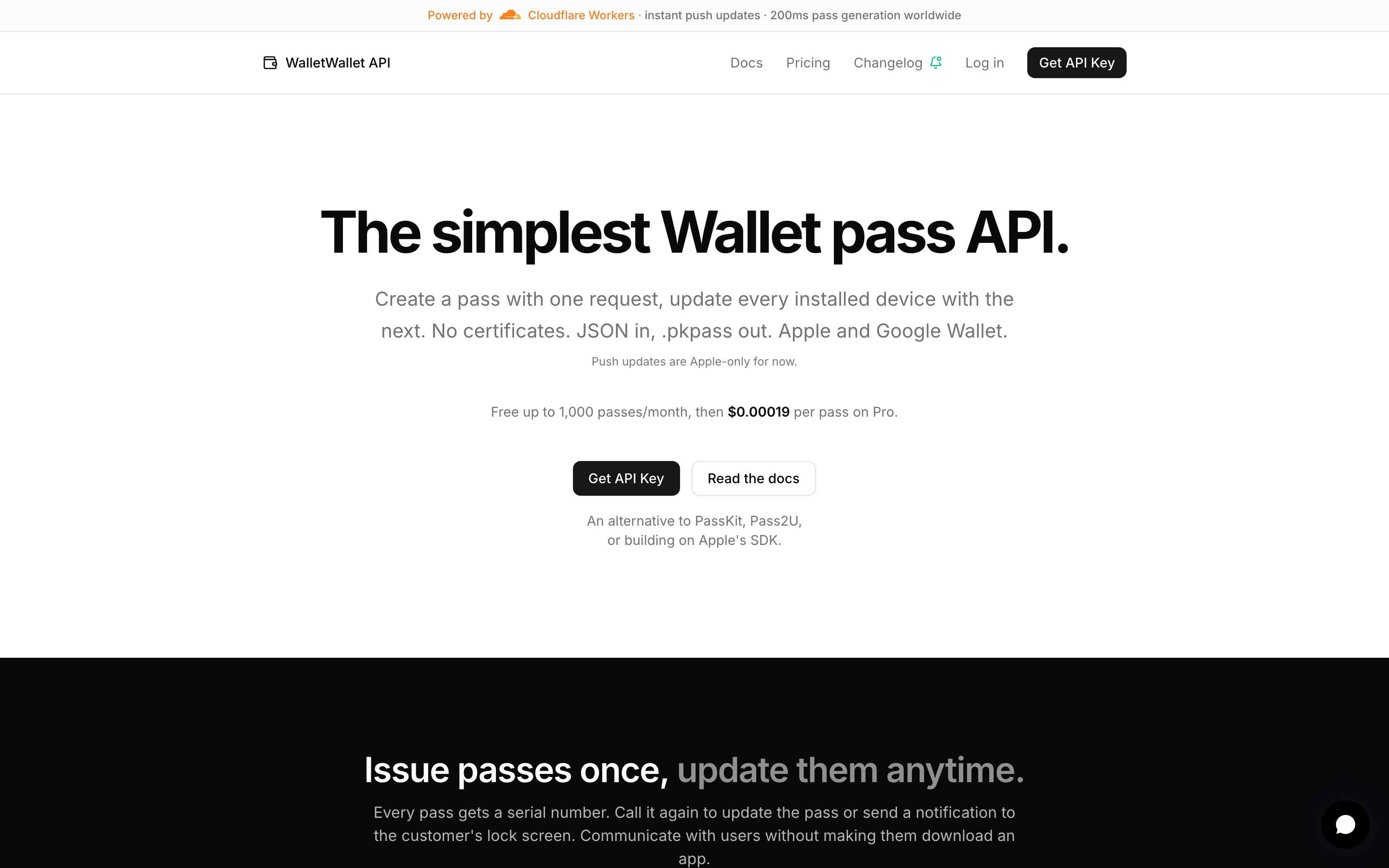
WalletWallet is a REST API for Apple Wallet and Google Wallet passes, with a dashboard for teams that prefer not to call the API by hand. One POST /api/passes returns the signed .pkpass, the Google Wallet save link, and a hosted share page, so a single request covers both wallets. Notable pieces:
- One request to both wallets:
POST /api/passesreturns the.pkpass, the Google save URL, and the share link. - Push updates:
PUT /api/passes/<serial>pushes a change to every installed device on both wallets. Each changed update counts once against the monthly allowance, with no separate update fee. - Up to 10 location triggers per pass and per field
changeMessagebanner text. - A hosted share page at
/p/<serial>with the right Add to Wallet button per device and a QR code on desktop. - A no code Pass Editor for designing passes and a Pro Pass Manager for finding, editing, notifying, exporting, and revoking issued passes.
- An API key you generate yourself from the dashboard, on every plan.
Side by side: how you issue a pass
Pass2U’s API model is create a Model (a pass template), then issue passes against it, then fetch the .pkpass binary for your own distribution. Authentication uses a 32 character Base64 API key in an x-api-key header, and the documentation notes a limit of 100 requests per second per key. The published API guide and endpoints center on Apple .pkpass output.
WalletWallet is a single call:
curl -X POST https://api.walletwallet.dev/api/passes \
  -H "Authorization: Bearer ww_live_..." \
  -H "Content-Type: application/json" \
  -d '{
    "type": "storeCard",
    "logoText": "Bayroast Coffee",
    "primaryFields": [{ "key": "balance", "label": "Points", "value": "1,250" }],
    "barcode": { "format": "qr", "message": "MEMBER-4471" }
  }'
The response carries the signed .pkpass, the Google Wallet save URL, and the share link in one shot. The difference in philosophy: Pass2U is a platform you adopt and distribute through (with an app, designer, and redemption flow), while WalletWallet is an API you call from your own product. Both are valid; the right one depends on whether you want a finished platform or a building block.
Pricing at common volumes
Pass2U is credit based. Verified credit packs (USD):
| Pack | Credits | Per credit |
|---|---|---|
| Free | 50 | $0 |
| $50 | 8,000 | $0.00625 |
| $100 | 20,000 | $0.005 |
| $200 | 50,000 | $0.004 |
| $400 | 120,000 | $0.0033 |
Verified per action credit costs for a Normal Pass: generation is 3 credits, email delivery is 3 credits, each update is 3 credits per pass, and redeeming or voiding is 0 credits. A Punch Card costs 10 credits to generate and 3 credits to update. Monthly Premium is available only for eligible Normal Pass models: $0/month per model for unlimited updates to 10 active passes, $39/month for 2,000 active passes plus 600 bonus credits, or $79/month for 5,000 active passes plus 1,500 bonus credits. Punch Card models are not supported. A model is one pass template, and each subscription covers one model.
WalletWallet uses a monthly operation allowance: Free covers 1,000 creations and changed updates with both wallets and no card, and Pro is $39/month for up to 100,000. Updates, push, location triggers, and both wallets have no separate per action fee, but changed updates count against the allowance.
What that means at a few real shapes of usage (Pass2U credit estimates use the per credit rate of the pack you would buy; credits are prepaid in packs, so the real spend rounds up to the next pack):
| Monthly usage | Pass2U | WalletWallet |
|---|---|---|
| 1,000 passes issued, no updates | 3,000 credits (one $50 pack) | Free |
| 10,000 passes issued, no updates | 30,000 credits (about $120 at the $200 pack rate; the $200 pack is the smallest that covers it) | $39 (Pro) |
| 10,000 passes, each updated 3 times | 120,000 credits (one $400 pack) | $39 (40,000 monthly operations, within Pro) |
The structural difference is updates. On Pass2U a pushed update is 3 credits per pass per update unless an eligible Normal Pass model is on Monthly Premium. On WalletWallet, a changed update consumes one monthly operation but has no separate fee. If your passes change often (loyalty balances, ticket times, status), compare Pass2U credits and active-pass quotas with WalletWallet’s monthly operation allowance.
Where Pass2U’s model can win: one eligible Normal Pass model with a small active audience. A model with up to 10 active passes can use the $0 Monthly Premium tier, while up to 2,000 active passes costs $39/month per model. The credit model also suits low and bursty volume where a monthly fee would sit idle.
What WalletWallet does not do (yet)
Pass2U is a broader product in several ways, and if you need these, Pass2U is the better pick:
- A consumer wallet app that holds and organizes passes across brands (Pass2U Wallet). Passes issued through WalletWallet live in the native Apple Wallet and Google Wallet apps instead. For a no code, consumer facing way to build a pass, there is a free builder at walletwallet.alen.ro.
- A built in checkout, redemption, and void flow for staff to scan and redeem passes in person (redeem and void are 0 credits on Pass2U).
- Punch card passes and loyalty point management as first class, packaged features.
- Beacon based distribution and a reseller program for agencies selling passes to clients.
If any of these are central to your project, Pass2U covers them out of the box and WalletWallet does not.
Feature comparison
| Feature | Pass2U | WalletWallet |
|---|---|---|
| Apple Wallet | ✓ | ✓ |
| Google Wallet | ✓ (platform) | ✓ (native, same request) |
| Google Wallet via REST API | Not publicly documented (API docs cover Apple .pkpass) |
✓ |
| Pricing model | Prepaid credits, per action | Flat monthly |
| Cost per pushed update | 3 credits per pass per update, or unlimited for an eligible Normal Pass model on Monthly Premium | Counts against the monthly allowance, with no separate update fee |
| Free tier | 50 credits | 1,000 creations and changed updates per month |
| Self serve API key | Full API access described as Enterprise, apply by email | ✓ on every plan |
| API rate limit | 100 requests per second per key | Documented in the API reference |
| Push updates | ✓ | ✓ |
| Location / lock screen relevance | Beacon distribution documented | Up to 10 location triggers per pass |
| No code designer | ✓ (web designer) | ✓ (Pass Editor) |
| Manage and re-push issued passes in a dashboard | Via designer and APIs | ✓ (Pro Pass Manager) |
| Consumer wallet app | ✓ | No |
| In person redeem / void service | ✓ | No |
| Punch cards / loyalty points service | ✓ | No |
| Reseller program | ✓ | No |
| Hosted share page per pass | Hosted pass pages | ✓ (/p/<serial>) |
A few items Pass2U does not publicly document, so we will not claim them either way: whether you can use your own Apple Pass Type ID certificate, the credit expiration policy, whether free tier passes carry Pass2U branding, and whether the REST API issues Google Wallet objects (the platform markets Google Wallet, but the public API documentation covers Apple .pkpass).
When Pass2U is the better pick
- You want a finished business product, not an API to build on: a consumer app, a web designer, and a redemption flow your staff can use.
- You need in person scanning, redemption, and voiding handled for you.
- You run punch cards or loyalty point programs and want those as packaged features.
- You are an agency and want a reseller program to sell passes to clients.
- Your volume is low or bursty, or one eligible Normal Pass model fits a Monthly Premium active-pass quota.
When WalletWallet is the better pick
- You are a developer and want to issue to both wallets from one
POSTin your own product. - You want flat, predictable pricing instead of metering credits per generate, email, and update.
- Your passes change often and you do not want each push to cost credits.
- You want a self serve API key without an enterprise plan and an email application step.
- You want Google Wallet through a documented REST API, not only through a hosted platform.
- You want a dashboard with Pass Editor and Pro Pass Manager so non developers can design and update passes without code.
- You want to issue a batch of passes from a spreadsheet without writing a script. Batch import takes a CSV with one row per pass, maps the columns into a single pass design as
{{column}}tokens, and returns a CSV of serial numbers and share links. Batches run up to 100 records on Free and 1,000 on Pro.
Try it before you decide
You can build and preview a pass in the editor without writing code, then copy the request when you are happy. Get a free API key (1,000 creations and changed updates per month, both wallets, no card) and read the docs to see the full two endpoint surface. If Pass2U’s app, redemption, or loyalty features are requirements, Pass2U remains the better fit.
FAQ
Is Pass2U free? Pass2U starts with 50 free credits, and generating a Normal Pass costs 3 credits, so the free credits cover a small number of passes. An eligible Normal Pass model can also use the $0 Monthly Premium tier for unlimited updates to 10 active passes. Punch Card models are excluded. WalletWallet’s free tier covers 1,000 creations and changed updates per month with no card.
Does Pass2U charge for updates? Yes, on the credit model an update is 3 credits per pass per update. Unlimited updates apply only to eligible Normal Pass models on Monthly Premium while they remain within the active-pass quota. Punch Card models are excluded. WalletWallet counts changed updates against its monthly allowance but does not charge a separate update fee.
Does Pass2U have a REST API?
Yes. It uses a 32 character API key in an x-api-key header and limits requests to 100 per second per key. Its documentation describes full Pass API access as an Enterprise plan feature that you apply for by email, and the documented endpoints center on Apple .pkpass output. WalletWallet issues an API key from the dashboard on every plan and returns both Apple and Google passes from one request.
Can I move from Pass2U to WalletWallet? Yes, but confirm how your passes were issued before planning the migration. If you can export the holder data, you can rebuild the design and import records into WalletWallet. Passes issued under Pass2U’s credentials normally need replacement. Confirm credential and identifier transfer with Pass2U, and plan separately for Pass2U checkout, points, analytics, Smart Tap, and reseller workflows.
Last verified 2026-08-04. Pass2U details from pass2u.net/pricing and pass2u.net/documentation. Items we could not confirm from a primary Pass2U page are stated as “not publicly documented” rather than as fact.
Try WalletWallet in 60 seconds
Sign up with just an email and verification code (no card), then generate your first signed .pkpass with one curl. Free tier covers 1,000 passes/month, indefinite.